
Dual Citizenship
Reacquire or retain your Philippine citizenship and enjoy the rights and privileges of being a Filipino while maintaining your foreign nationality, in accordance with Philippine law.
⚠️Important Notice
Applications for Dual Citizenship Services are accepted by appointment only. Please schedule an appointment before visiting the Consulate. Walk-ins will not be accommodated. Applicants are expected to wear appropriate attire for their appointment. Clothing that is overly casual, revealing, or contains offensive language or images should be avoided.
📅Before You Schedule an Appointment
Please review the applicable documentary requirements and download the necessary forms before booking an appointment.
Applicants with incomplete documentary requirements may be asked to reschedule their appointment or submit additional documents before their application can be processed.
Please ensure that you have:
✓ Reviewed the documentary requirements for your chosen service
✓ Downloaded and completed the necessary forms
✓ Prepared all supporting documents
✓ Checked applicable fees and payment requirements
✓ Verified your appointment details before submission
Bring the following:
✓ Appointment confirmation
✓ Original documents
✓ Photocopies of supporting documents
✓ Completed forms (if applicable)
✓ Applicable fees
💳Payment Reminder
The Philippine Consulate General in Seattle accepts CASH ONLY as payment for all consular services.
For applications submitted by mail, Payment should be in the form of a money order or cashier’s check payable to the Consulate General of the Philippines in Seattle. DO NOT SEND CASH BY MAIL.
Overview
You can reacquire your Philippine citizenship and become a dual citizen if you: (1) were born Filipino; (2) became a citizen of another country; (3) are at least 18 years old; and (4) personally appear at the Philippine Consulate General in Seattle. Appointment at the Philippine Consulate is required and the process is completed on the same day.
General Information
To be eligible for dual citizenship under Republic Act No. 9225 (Dual Citizenship Law), you must be a former natural-born Filipino citizen who became a naturalized citizen of another country.
You can also include your unmarried children under 18 in your application so they can become Filipino citizens too. Their presence is not necessary during the appointment.
Who is Considered A Natural-Born Filipino?
To be eligible for dual citizenship under Republic Act 9225, you must be a former natural-born Filipino citizen who has become a naturalized citizen of another country.
You are a natural-born Filipino citizen if you were:
a. Born starting January 17, 1973: One of your parents was a Filipino citizen when you were born.
b. Born before January 17, 1973 and your parents were married: Your father was a Filipino when you were born. Or, if your father was not Filipino, you elected Philippine citizenship upon reaching the age of majority.
c. Born before January 17, 1973 and your parents were not married: Your mother was a Filipino when you were born.
Check if You Are A Dual Citizen at Birth
If you were born outside the Philippines on or after 17 January 1973, you are a Filipino citizen as long as one of your parents was a Filipino citizen at the time of your birth.
So if one of your parents was Filipino when you were born in the United States, you are a dual citizen at birth. If this applies to you, you are already Filipino by birth and do not need to apply for dual citizenship. You only need to file a Report of Birth to the relevant Philippine Embassy/Consulate with jurisdiction over the place of your birth for recognition as a Filipino citizen.
How to Apply
Appointment is required for this service. Click the button below to set an appointment online.
Complete the necessary forms and gather required documents before your appointment. Incomplete applications will not be processed.
On the day of your appointment, go to the Consulate to submit your application form and supporting documents, and pay the processing fee. Please bring a pen for filling out and signing forms during your appointment. Minors are not required to be present at the appointment.
Together with all dual citizenship applicants for the day, attend the briefing and take the oath of allegiance to the Republic of the Philippines in front of a Philippine consular officer.
You have the option to apply for a Philippine passport after the oath taking ceremony. You can report your marriage and the birth of your child to the Embassy. You can also get a certified true copy of your dual citizenship certificate.
What to Bring
This list of requirements are for those who are applying for citizenship in Seattle. The Consulate has no photocopier/printer onsite. If applying at one of our consular outreach missions, please visit this page for the instructions.
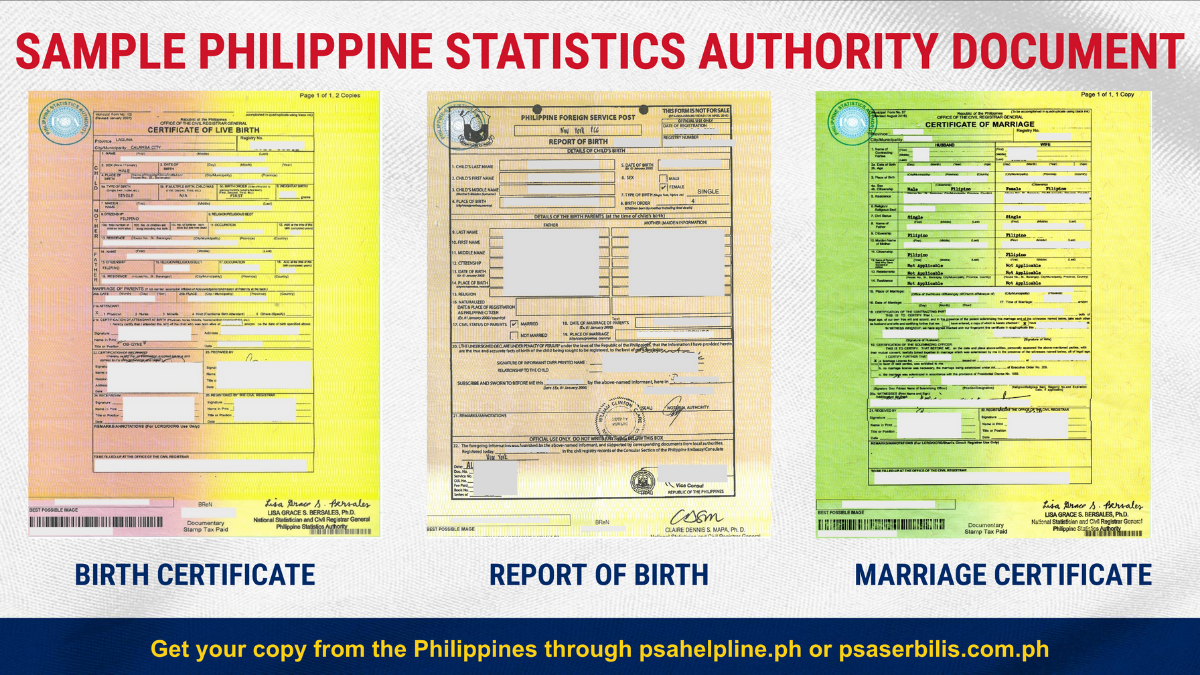
- Original and one (1) photocopy of the birth certificate issued by the Philippine Statistics Authority (PSA) on security paper (not from the Local Civil Registry Office)
- See sample here
- If you do not have a birth certificate issued by the PSA on security paper, please order online through psahelpline.ph or psaserbilis.com.ph
- Original and one (1) photocopy of the Naturalization Certificate issued by the foreign government
- Original and one (1) photocopy of the data pages of both Philippine and foreign passports, whether valid or expired
- Two (2) recent color 2″ x 2″ photos, taken within the last six months, with a white background
- Original and one (1) photocopy of documents that will support the change of name such as:
- Marriage certificate / Report of marriage
- Annotated birth certificate
- Annotated marriage contract to show annulment/divorce/court order
- Death certificate of spouse
- Birth certificate before and after adoption
- Court decision or order on adoption and Certificate of finality
- Your dual citizenship identification certificate will bear all the names you have used in your application documents. However, if you are getting a Philippine passport, only PSA-issued documents can be used as a basis for the name on your Philippine passport.
- USD 50.00 processing fee for each adult principal
- The Philippine Consulate General in Seattle accepts cash only as payment for all consular services.
- Personal checks are not accepted
Documentary Requirements for Derivative Citizenship of Minors:
- Two (2) recent color 2″ x 2″ photos
- One (1) original and one (1) photocopy
- Original and one (1) photocopy of the data pages of the Philippine and/or foreign passports, if available
- USD 25.00 for each minor derivative
- The Philippine Consulate General in Seattle accepts cash only as payment for all consular services.
Minors are included in their parent’s application and are not required to be present at the appointment.
Next Steps
After successfully reacquiring Filipino citizenship, you can take several actions to further formalize your status and update your records with the Philippine government:
You have the option to get a Philippine passport. The Philippine passport application is a separate transaction from the dual citizenship application and requires a separate appointment. Applicants must secure a passport appointment and comply with the applicable passport requirements.
Please note that the name on the passport will follow the name reflected in the applicant’s PSA documents. The Consulate cannot use non-PSA documents as a basis for changes to the name appearing on the passport.
Answer:
Natural-born Filipino citizens are those who are citizens of the Philippines from birth without having to perform any act to acquire or perfect their Philippine citizenship. The following are considered natural-born Filipino citizens:
- LEGITIMATE CHILD BORN BEFORE 17 JANUARY 1973: The father was a Filipino citizen at the time of the child’s birth, as indicated in the PSA Birth Certificate. If the father is not Filipino, the child must have formally elected Filipino citizenship upon reaching the age of majority.
- ILLEGITIMATE CHILD BORN BEFORE 17 JANUARY 1973: The mother was a Filipino citizen at the time of the child’s birth, as indicated in the PSA Birth Certificate.
- CHILD BORN ON OR AFTER 17 JANUARY 1973: The father or mother was a Filipino citizen at the time of the child’s birth, as indicated in the PSA Birth Certificate.
For children born outside the Philippines, it is important to report their birth to the Philippine Statistics Authority through the Embassy/ Consulate General with jurisdiction over the place of birth. Applications must be submitted by mail, but you have the option to submit it on the same day of your oath taking ceremony.
Your foreign spouse can apply for a permanent resident visa [13(A) visa]. Applications must be submitted by mail.
If the overseas voter registration period is open, you can register as an overseas voter on the same day you obtain dual citizenship.
Frequently Asked Questions
Answer:
Natural-born Filipino citizens are those who are citizens of the Philippines from birth without having to perform any act to acquire or perfect their Philippine citizenship. The following are considered natural-born Filipino citizens:
- LEGITIMATE CHILD BORN BEFORE 17 JANUARY 1973: The father was a Filipino citizen at the time of the child’s birth, as indicated in the PSA Birth Certificate. If the father is not Filipino, the child must have formally elected Filipino citizenship upon reaching the age of majority.
- ILLEGITIMATE CHILD BORN BEFORE 17 JANUARY 1973: The mother was a Filipino citizen at the time of the child’s birth, as indicated in the PSA Birth Certificate.
- CHILD BORN ON OR AFTER 17 JANUARY 1973: The father or mother was a Filipino citizen at the time of the child’s birth, as indicated in the PSA Birth Certificate.
Answer:
Natural-born Filipino citizens are those who are citizens of the Philippines from birth without having to perform any act to acquire or perfect their Philippine citizenship. The following are considered natural-born Filipino citizens:
- LEGITIMATE CHILD BORN BEFORE 17 JANUARY 1973: The father was a Filipino citizen at the time of the child’s birth, as indicated in the PSA Birth Certificate. If the father is not Filipino, the child must have formally elected Filipino citizenship upon reaching the age of majority.
- ILLEGITIMATE CHILD BORN BEFORE 17 JANUARY 1973: The mother was a Filipino citizen at the time of the child’s birth, as indicated in the PSA Birth Certificate.
- CHILD BORN ON OR AFTER 17 JANUARY 1973: The father or mother was a Filipino citizen at the time of the child’s birth, as indicated in the PSA Birth Certificate.
Answer:
Applicant shall submit his/her Birth Certificate (original and photocopy) issued by the Philippine Statistics Authority (PSA), formerly National Statistics Office (NSO). If you do not have a copy of your birth certificate, you may request a certified copy online through their website: (https://www.psaserbilis.com.ph/Default.aspx).
Answer:
Prospective applicants for dual citizenship under R.A. 9225 are advised to visit and read the contents of the website of the U.S. Department of State which contains information about current U.S. government policy on dual nationality, or to seek legal advice from a U.S. immigration lawyer.
Answer:
You should obtain a Certification from the US Citizenship and Immigration Services (USCIS) indicating the details of your naturalization, including the date of naturalization and Certificate number. You may e-mail [email protected] regarding this or visit the following website: https://www.uscis.gov/n-565
Answer:
The Consular Officer will administer the Oath of the applicants at 5:30 p.m. on the same date of application.
Answer:
The ceremony is a solemn and meaningful event. Please dress in a proper attire to respect the dignity of the event.
Answer:
Applicant may a) execute an Affidavit (click here to download form) explaining the discrepancy, and b) present original and submit photocopy/copies of at least two (2) public or private documents showing the correct name of the applicant. This Affidavit has to be notarized.
Answer:
No, you can no longer use your valid Philippine passport and the same will be cancelled physically by the Consular Officer. Applicants are asked to surrender their existing Philippine passports (if still valid) and are advised to apply for a new one only after taking their Oath as a dual citizen and not earlier. The latest Philippine passport has been rendered null and void the moment you were naturalized as a U.S. citizen.
Answer:
The application for a Philippine passport is a separate transaction. Applicants remain ineligible to apply for a new passport until they have taken their oath.
Answer:
Application for a Philippine passport is optional and not mandatory. It should be noted that the Identification Certificate issued by the Philippine Embassy/Consulate General is considered sufficient proof of Philippine citizenship for those persons entering or leaving the Philippines holding foreign passports. Applicants may also apply for a Philippine passport, which is considered a universally recognized government issued identification document (ID).
Answer:
Persons who wish to declare their dual citizenship are advised to present their foreign passport as well as their valid Philippine passport and/or Identification Certificate upon entering and departing the Philippines.
Answer:
An immigrant visa may be issued to a Filipino citizen’s foreign spouse that entitles him/her to permanently reside in the Philippines. Said visa may be obtained by applying at the Philippine Embassy/Consulate General and with the Philippine Bureau of Immigration. The validity of the visa, however, is contingent upon the Filipino citizenship of his/her spouse.
Answer:
Under the Balikbayan Program, a Filipino citizen’s foreign spouse and children traveling to the Philippines do not need to secure other travel documents because they are entitled to a visa-free entry to the Philippines for a period of one (1) year, among other privileges provided they travel together with the former Filipino spouse or parent. Otherwise, if the foreign spouse or child is a visa-required national, he or she would need to apply for an appropriate visa.
Please note that at this time of pandemic, the Balikbayan Program may be suspended. As such, the foreign spouse or child may need to apply for an entry visa. For inquiries, please send an email to [email protected].
Answer:
Residency in the Philippines is not a requirement for those who reacquired/retained their Philippine citizenship. Those who intend to vote in local elections, however, must establish residence in the locality where they wish to vote.
Answer:
You can now reside in the Philippines indefinitely and for as long as you want without having to apply for a Philippine visa and pay immigration fees. You can even choose to retire or permanently reside in the Philippines, provided you show proof of your Dual Citizenship (e,g, Identification Certificate) together with your U.S. passport upon arrival and departure in the Philippines.
Answer:
You will enjoy all full civil, economic and political rights enjoyed by Filipino citizens. Among them are:
1. Travel using a Philippine passport
2. Ownership of real property in the Philippines {subject to limitations provided by law)
3. Engage in business, trade and commercial activities
4. Practice one’s profession, in accordance with existing Philippine Laws; A person who has reacquired Philippine citizenship may be able to practice his/her profession in the Philippines, provided that he/she applies with the Professional Regulation Commission (PRC), the Supreme Court for Lawyers, and other applicable Philippine agencies or bodies for a license or permit to engage in such professional practice. Those appointed to a public office shall make a sworn renunciation of the oath of allegiance to the country where they took their oath.
5. Exercise of right to vote or suffrage during Philippine elections and that the individual must comply with the residency requirement under existing Philippine election laws. The person or individual may, however, vote overseas in Philippine national elections (for President, Vice-President, Senators and sectoral representatives) in accordance with the provisions of the Overseas Absentee Voting Act of 2003.
6. Your foreign spouse also becomes eligible for an immigrant visa
7. All other rights and privileges enjoyed by Filipino citizens
Answer:
Travel Tax exemption is being granted to dual citizens departing the Philippines and returning to the U.S. whose arrival is stamped on the Philippine passport and whose stay does not exceed one (1) year. For this purpose, a Travel Tax Exemption Certificate is issued upon presentation of both the Philippine and US passports. Processing fee of PHP 200.00 is collected for every certificate issued.
Dual citizens whose stay in the Philippines exceed one (1) year will pay the travel tax irrespective of which passport they use for travel.
Answer:
Only Income/s earned in the Philippines will be subject to Philippine Income Tax. Prospective applicants are advised to visit and read the contents of the website of the U.S. Internal Revenue Service, which contains information about current U.S. government policy on taxes on incomes earned worldwide, or to seek legal advice from a U.S. tax lawyer.
For Inquiries: Please send an email to [email protected].